
Period management in young people with disabilities
Ellie is 14 years old, and she has athetoid cerebral palsy. She has limited use of her hands and is in a wheelchair. She started her periods 3 months ago, and she finds them very distressing. She comes to see you with her mum to ask about options to help.
Mum asks if “ she should go on the pill to help” because that’s what Mum was given 30 years ago for her own menstrual problems.
Why are we talking about this?
Menstrual disorders are common (10% of all teens will need treatment for heavy menstrual bleeding, for example). Dysmenorrhoea is very common in all young women. It can be extremely disabling or frightening, especially if an adolescent does not have the language skills to articulate the issue or the receptive understanding to have it explained to them. Periods, and especially period products, may be extremely difficult to manage for a young person with a physical or mental disability.
“Triple incontinence” (bowel/bladder/menstrual blood) can have serious consequences for skin integrity. While there are a number of strategies to help, gynaecology is often not part of the paediatric curriculum. Here at DFTB, we are going to try to fix this.
Sexuality and sexual behaviour are not the exclusive privileges of the neurotypical, but, unfortunately, the risk of abuse, coercion, sexually transmitted infections (STIs), and pregnancy is higher in people with physical or learning disabilities.
What do we need to know from Ellie and her mum?
A clear menstrual history is key here but most important is focusing on their ideas, concerns and expectations. We’ve already heard from the mother that she thinks “the pill” could be the solution, but we need to know more about what is happening, what is bothering them and what they think might help.
- Is the issue simply periods per se and the manual dexterity challenges of managing pads/tampons independently?
- Does she have heavy bleeding?
- Are her periods significantly painful?
- Are there concerns about relationships and sexual activity?
Remember, Ellie is a teenager. She’s likely to have crushes, to fancy boys (or girls) and to be exploring her own sexual identity. This can be really hard to come to terms with as a parent of any child, but as the parent of a child with a disability, this can be particularly frightening. There is a huge taboo surrounding the idea of disabled people having sex (more to come in a future article).
Ellie tells you she has had three periods so far. She bleeds for 4-5 days each time and gets a bit of lower abdominal cramping. This settles with paracetamol or ibuprofen. She needs her sanitary pads changing every 3-4 hours, and this is really upsetting as her hands won’t let her peel the sticky strips from the back of the pad, and she has to get someone else to do it for her.
She’s in a mainstream secondary school with some writing and mobility support, but her 1:1 teaching assistant can’t help her with personal care, so on period weeks, her mum has to come into school 2-3 times in the day to change her pads. Ellie finds this humiliating as she is really independent with everything normally.
Ellie knows about sex and relationships and has a bit of a thing for a boy in her French class. She’s open and aware of pregnancy and STIs, having been to lots of PHSE lessons recently, and does not want or need contraception currently.
What options are there for helping Ellie with her periods?
The key thing here is not to over-medicalise the situation but to recognise that being a menstruating adolescent with physical disabilities can be challenging.

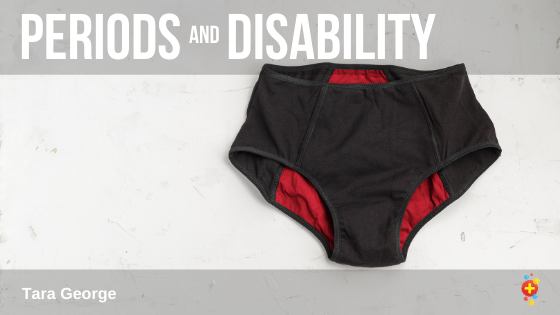
Consider period pants
Liaise directly with school nurses
Medication based approach

Progestogen-only pill
- Shouldn’t be used as a first-line agent, as erratic bleeding is common
- It needs to be taken daily
- 50% of young women will have amenorrhoea by six months with desogestrel
Combined Pill
- Commonly used, such as the 150/30mcg Levest
- Prescribers need to consider relative contraindications such as immobility, BMI and enzyme-inducing medication and absolute contraindications such as a history of migraines or family or personal history of venous thrombo-embolism
- Targeted regimes (bi- or tri-cycling) may be used to induce the longest period of amenorrhoea
- Loestrin can be crushed and flushed down a gastrostomy tube if swallowing is a challenge

Transdermal contraceptives
- E.g. Evra
- They have the same relative and absolute contra-indications as the combined oral contraceptive pill
- Weekly application is easier than daily tablets
- A sequentially tailored regime can be used to manage bleeding

Depo progestogen
- 70% will have amenorrhoea by 12 months
- This is the most commonly used method
- Sayana-Press may be given by the carer—it is a subcut injection that is less painful and easier for the teen.
- Known side effects include weight gain, which may further impede mobility or challenge carers.
- If the teen is of lower BMI and relatively immobile, it may increase the risk of osteoporosis, necessitating the use of supplemental medication.
Intra Uterine Devices (IUDs)
- E.g the Mirena. It works by slowly releasing progestogen into the uterus
- Licensed for 5 years
- No drug interactions
- Amenorrhoea is common and dysmenorrhoea tends to improve
- The uterine cavity needs to be at least 6cm
- Needs a degree of mobility (and consent) to fit in a routine clinic
- It may be more appropriate to fit under GA
Contraceptive implant
- E.g. Nexplanon (etonogestrel)
- Only a 20% amenorrhoea rate and erratic bleeding are common, though it is usually lighter and less painful
- The 3-year license means better concordance
- There is a risk of the teen picking at the implant site, so it may be better to implant in the dominant arm by the triceps
- Removal can be tricky, so current guidelines suggest putting in a second implant and just leaving the old one in place
Ellie and her mum decided to try some period pants and to speak to the school nurse about changing facilities at school. After another two months, she’s still struggling on days 1 and 2 with changing her pants but can manage a whole school day in one pair of “nighttime” pants on days 3-5.
She opts to try the combined pill with a tailored regimen, allowing days 1-2 of her bleed to be scheduled for weekend days.
Selected references
Dickson J, et al. Contraception for adolescents with disabilities: taking control of periods, cycles and conditions. BMJ Sex Reprod Health 2018;44:7-13


