
Coarctation of the aorta
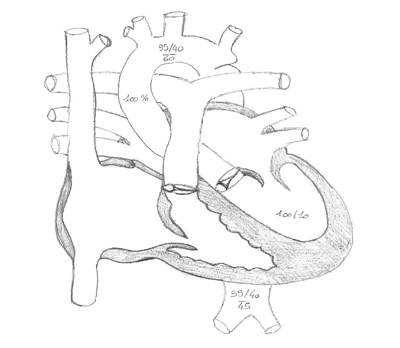
Definition: obstructive anomaly of the aortic arch.
Classification by Amato et al:
I. CoA with or without PDA (a. with VSD, b. with other defects)
II. CoA with isthmus hypoplasia with or without PDA (a. with VSD, b. with other defects)
III. CoA with tubular hypoplasia of the isthmus with or without PDA (a. with VSD, b. with other defects).
Prevalence 5-8% of all CHD.
Incidence 4:10.000 of all life births.
Genetic association to Trisomy 13 and 18.
Physiology:
With PDA closure there is an acute increase in LV afterload. This causes decreased CO and increased LVEDP leading to CCF (in extreme: myocardial ischemia) and shunt reversal along PFO (and VSD if present). Consequently there is increased PBF causing severe CCF with systemic hypotension.
In older children with less obstruction, the physiology is less severe and there will be LVH and aortic collateralisation.
Diagnosis:
Rarely referred in newborn period (PDA): hypertension of upper limbs usually not present before Day 5
Usually presents after PDA closure with signs of CCF of various degrees
ECG: signs of RVH, later RVH and LVH
CXR: cardiomegaly and pulmonary congestion
Cardiac catheterisation (diagnostic and interventional)
MRI
Preoperative management:
- Commence prostaglandine E1 (20 ng/kg/min) to maintain systemic perfusion. Intubate and sedate to lower oxygen consumption. Hypoventilation to increase the PVR and to lower the SVR
- Balanced circulation with PDA open and/or VSD present (aim SpO2 75-85%)
- Dopamine (5-10 mcg/kg/min), dobutamine (5-10 mcg/kg/min) or adrenaline (0.02-0.1 mcg/kg/min) may be required to stabilise for low CO
- Careful fluid resuscitation (obstructive lesion, not hypovolaemic)
- In older children: treat hypertension with β-Blocker (ie propanolol 1.5 mg/kg/day oral or metoprolol 0.1 mg/kg/dose IV or esmolol infusion)
Preoperative preparation:
ECG, CXR, CUS, FBE, clotting, UECs, FISH, PRBC(4), FFP (2), platelets (2), cryoprecipitate (2).
Methylprednisolone 10 mg/kg 12 hrs and 6 hrs pre surgery in neonates, arterial line on right upper limb.
Surgery:
Resection of the stenotic segment and end-to-end or end-to-side anastomosis, patch augmentation, subclavian-flap aortoplasty or extended resection with primary anastomosis.
Prosthetic graft in older children or adolescents.
Angioplasty (balloon) or stent insertion in selected cases.
Postoperative management:
- Keep intubated, ventilated, sedated and paralysed for 24 hours for patients with preceding high PBF; elective cases can be extubated within 4hrs
- Inotropes: milrinone plus dopamine or adrenaline
- Haemodynamics: age adjusted, in neonates: SBP >60 mmHg but <80 mmHg, MAP >40 mmHg; prevent hypertension (SNP infusion or esmolol infusion).
- Respiratory: normoxaemia, normocapnea.
- Fluid restriction: 1 ml/kg/hr, trophic feeds only
- Haemostasis, Hb 120-140 g/L
- Keep normothermic
Specific problems:
- Acute hypertension (increase of noradrenaline release due to sympathetic stimulation during repair): SNP or esmolol infusion
- Postcoarctectomy syndrome: hypertension, abdominal pain, ileus (2-3 days post repair): antihypertensive treatment
- Pumonary hypertension if high PBF was preceding (VSD or ASD)
- Thoracic duct injury with chylothorax
- Laryngeal nerve injury
- Spinal cord injury (A. spinalis anterior injury): 0.4-1.5%
- Aneurysmatic dilation (up to 35%)
Outcome:
Perioperative mortality: <1% in isolated CoA, but 5-7% in CoA plus VSD, up to 50% in CoA plus HLHS or other defects.
Recoarctation 5-50%.
Long term antihypertensive treatment required in 30%.
Long term survival after 30 years: 80%.
References:
[1] Critical Heart Disease in Infants and Children; 2nd ed, Nichols et al: Coarctation of the Aora
[2] Pediatr Cardiol. 2010 Dec 25: Gillett et al: Underrecognition of Elevated Blood Pressure Readings in Children After Early Repair of Coarctation of the Aorta
[3] Ann Thorac Surg. 2009 Dec;88(6):1923-30; discussion 1930-1: Brown et al: Recurrent coarctation: is surgical repair of recurrent coarctation of the aorta safe and effective?
[4] Curr Opin Cardiol. 2009 Nov;24(6):509-15: Tanous et al: Coarctation of the aorta: evaluation and management.
[5] Am J Cardiol. 2013 Feb 19: Gray et al: Long-Term Follow-Up of Neonatal Coarctation and Left-Sided Cardiac Hypoplasia.
All Marc's PICU cardiology FOAM can be found on PICU Doctor and can be downloaded as a handy app for free on iPhone or Android. A list of contributors can be seen here.


