
Neonatal herpes

You are on labour ward duty, and the Obstetrics resident gives you a call. A woman has just been admitted to the ward. She is 38 weeks pregnant, is in active labour, and has ruptured membranes.
She told the nurse that she had an eruption of genital vesicles four weeks ago, which she had never had before. She did not seek medical help then, and the vesicles disappeared after a week.
The resident asks you whether you think this might have been genital herpes and whether it is the reason for a caesarean.
Disease caused by Herpes Simplex Virus (HSV) types 1 and 2 can have devastating consequences. It can be caused by vertical transmission from mother to child during pregnancy and delivery, but horizontal transfer after birth can also occur. Neonatal herpes can present with various symptoms, and diagnosis can be challenging. Fortunately, it is rare: the incidence is around 1:3,000 to 15,000 live births in developed countries.

Pathophysiology of neonatal herpes
There are two types of HSV: type 1 and type 2. Classically, HSV-1 is more prevalent in the oral area (e.g. producing cold sores), and HSV-2 occurs most often genitally. Still, this distinction is not absolute, as both can be present in each anatomic site. HSV is very common, and most of the population worldwide has been exposed to it, HSV-1 being the most common. Many people have regular recurrences of symptoms throughout their lives.
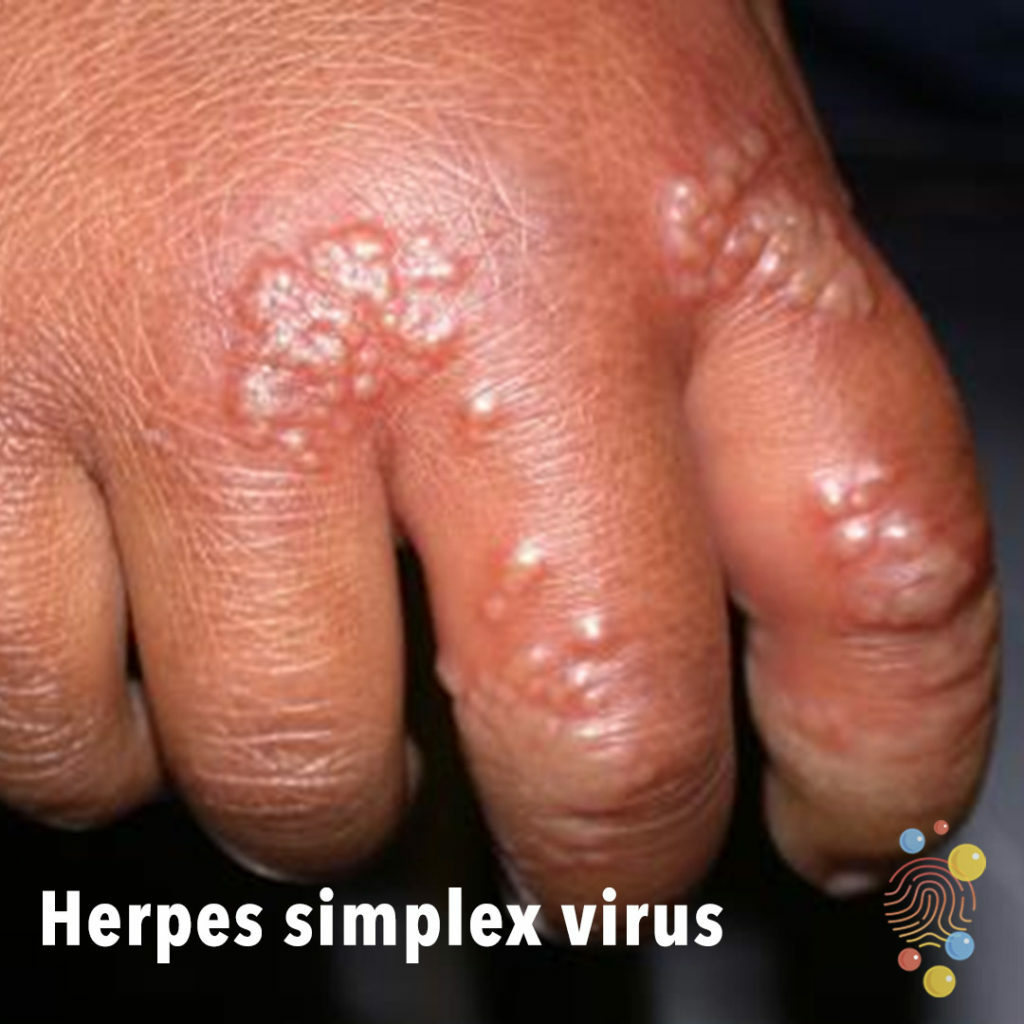
Neonatal herpes acquired peri- or post-partum causes three different types of disease entities which are not entirely mutually exclusive:

Symptoms of neonatal herpes
-
Skin Eye Mouth (SEM) disease is a local infection affecting the skin and mucosa without the involvement of visceral organs. The incubation time is usually 7-12 days. The prognosis of SEM disease is good, but there can be long-term consequences such as eye damage and scarring. Neurological involvement can sometimes be subtle and presents itself in 5-10% of patients.
-
Central nervous system (CNS) involvement, with incubation of up to six weeks, can occur with or without skin symptoms. Mortality is around 4% despite treatment (and 50% without treatment), and significant morbidity can occur. Only 1/3 of babies with CNS disease subsequently have normal neurological development.
-
Disseminated infection in which skin, mucosa, as well as other organs (such as lungs, liver, adrenal glands) are affected. The presenting symptoms are subtle, such as lethargy, feeding difficulties, vomiting, and fever. Later, multi-organ failure, pneumonia, hepatomegaly, and CNS involvement (encephalitis, meningitis) can occur. The mortality is high (~30%), especially in cases with delayed diagnosis.
-
In addition, HSV can cause in-utero disease, which is rare but has severe sequelae. Babies are usually born with severe scarring, eye problems, and neurological problems (hydranencephaly, calcifications, microcephaly). Few survive.
Neonatal herpes can predispose to dermal recurrences in the future, for which prophylaxis may be necessary. Neonatal herpes also increases the risk of autoimmune encephalitis.




Diagnosis
Be aware that typical cutaneous signs are only present in 50% of cases in neonates, so testing for herpes is also important when symptoms are less clear-cut. The standard diagnosis of neonatal herpes is by PCR (on both HSV types), performed on swabs (cutaneous, nasopharyngeal mucosa, ocular, rectal), serum, and liquor.
When testing is done immediately after birth, for example, if a woman has symptoms during delivery, swab results can be false-positive due to left-over HSV of maternal origin. It is, therefore, advised to sample these swabs 24 to 48 hours after birth. Liquor PCR can be false-negative in an early disease stage and may have to be repeated if suspicion is high and no other organisms were identified the first time.
Additionally, viral culture of skin and mucosa can be performed, but it is less common nowadays. Liver function testing can sometimes be useful as elevated liver enzymes are an early clue for disseminated infection.
HSV-1/2 viral load testing in serum and liquor can also be performed after treatment to inform disease progression and effectiveness. In the case of CNS disease, a proof-of-cure lumbar puncture is advised. This is usually done after three weeks of treatment.
Prevention of neonatal herpes
The Obstetrics team tests the mother’s blood for HSV-1 and HSV-2 serology. The results are unlikely to be known before delivery, so they advise a caesarean section to the mother, which she declines.
Whether a mother has had a previous genital infection (i.e. a recurrence) or not (a primary infection) helps direct obstetric management. A baby born around a primary infection is not protected against HSV because there is no protective antibody response. Therefore, a primary caesarean section is advised if the primary infection occurs in the third trimester.
Some guidelines allow for a vaginal birth if five to six weeks have passed between the symptoms and delivery. If someone prefers to deliver vaginally, the membranes should remain intact for as long as possible, scalp electrodes should not be used, and giving intravenous aciclovir to the mother should be considered. However, there is no evidence for the latter.
Women with primary herpes during the first or second trimester of pregnancy should be treated with aciclovir during this episode, with oral aciclovir started again after 36 weeks of gestation to minimise the chance of erupting lesions during delivery.
Serology is sometimes used to differentiate between a primary or secondary infection, but it has little value in the acute setting, and HSV IgM tests are unreliable. Some guidelines differentiate between a first and subsequent recurrences, the rationale being that a first recurrence poses a greater risk due to insufficient antibody response, but this has not been studied extensively.
The prevention of horizontal transmission is also important. If someone has active labial or cutaneous herpes, direct contact with the baby should be avoided. Masks should be worn in the case of a cold sore, and proper hygienic measures, e.g. washing hands, should be taken.
Treating neonatal herpes
Treatment is best done in consultation with a paediatric infectious disease expert:
-
Babies born vaginally during or after primary infection in the third trimester should be started prophylactically on intravenous aciclovir. Some guidelines, but not all, advise to test blood and liquor on the first day. The babies should be screened for neonatal herpes with cutaneous, nasopharyngeal, rectal, and ocular swabs taken 24 hours after birth.
-
If babies are born vaginally during active suspected or proven maternal herpes, some guidelines advise HSV screening and treatment even if the episode is a recurrence. However, data on the correct approach is scarce.
-
Treatment is unnecessary if a primary caesarean section has been performed, but the baby should be observed and only sent home after giving safety-netting tips.
-
Opinions differ on whether all babies presenting with sepsis during the first month should be presumptively treated with aciclovir, but testing is essential.
-
Aciclovir can be stopped if the PCR is negative and suspicion of the disease is low.
-
If positive, the duration of aciclovir treatment is generally 14 days in SEM and at least 21 days in disseminated or CNS disease.
-
Evaluation of coagulopathy and neural function is important during treatment.
-
Aciclovir is nephrotoxic and can cause neutropenia (usually transient) and elevated liver enzymes. It is, therefore, important to test for these changes during therapy.
-
Ocular treatment may be needed; it is always a good idea to consult an ophthalmologist for skin involvement.
-
After treatment, it is important to ensure adequate follow-up, especially in cases of CNS disease and/or disseminated disease, as morbidity can be significant. This is best done as part of a multi-disciplinary team.
-
Oral therapy is often given after intravenous aciclovir to prevent recurrences; please refer to local guidelines for the exact duration, as this might vary (usually six months). Regular lab testing for neutropenia is advised. Some children may need long-term prophylaxis, e.g., in families with a history of invasive herpes infections.
A baby boy, Frank, is born with good Apgar scores. Physical examination is unremarkable. You take blood and liquor for HSV PCR and start intravenous aciclovir. The next day, you take swabs of the nasopharynx, conjunctivae, rectum, and skin. All PCR tests return negative a day later, and the aciclovir is discontinued. Frank is sent home after giving safety-netting tips to the parents. At a polyclinical visit two weeks later, he had no symptoms.
The take home
Neonatal herpes is rare, but its consequences can be devastating; awareness of the disease and its varying presentations, and testing when you suspect it, is therefore essential.
Literature List
-
Baldwin S and Whitley RJ. Intrauterine herpes simplex virus infection. Teratology 1989;39:1-10.
-
Brown EL et al. Effect of maternal herpes simplex virus (HSV) serostatus and HSV type on risk of neonatal herpes. AOGS 2007;86:523-9.
-
Brown ZA et al. Effect of serologic status and cesarean delivery on transmission rates of herpes simplex virus from mother to infant. JAMA 2003;289:203-9.
-
De Tiège X et al. The spectrum of herpes simplex encephalitis in children. E J Paed Neur 2008;12:72-81.
-
Doare KL et al. Fifteen minute consultation: Managing neonatal and childhood herpes encephalitis. ADC Ed Practice 2015;100:58-63.
-
Gardella C et al. Poor correlation between genital lesions and detection of herpes simplex virus in women in labor. Obs & Gyecol 2005;106:268-74.
-
Kimberlin DW et al. Application of the polymerase chain reaction to the diagnosis and management of neonatal herpes simplex virus disease. J Infect Dis 1996;174:1162-67.
-
Kimberlin DW. Neonatal herpes simplex infection. Clin Microbiol Rev 2004;17:1–13.
-
Kliegman R (editor). Nelson textbook of pediatrics. Edition 21. Philadelphia, PA: Elsevier, 2020.
-
Scott JH & Kimberlin DW. Neonatal herpes simplex infection. Inf Dis Clin North Am 2015;29:391-400.

