
G6PD Deficiency
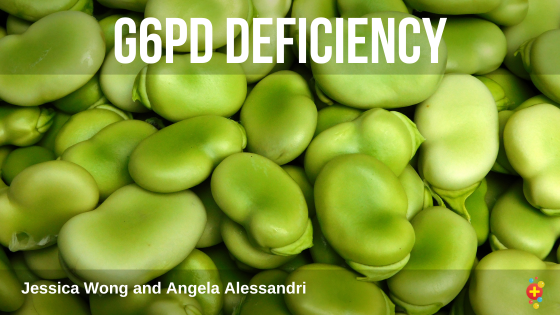
4-year-old Mark presents with lethargy, jaundice, and abdominal pain after eating one portion (40g) of broad beans.
Could he have G6PD deficiency?
G6PD, short for glucose-6-phosphate dehydrogenase, is an enzyme active in all cell types and is key to protecting red blood cells from oxidative damage and early destruction. When exposed to specific triggers, a child with reduced G6PD enzyme activity has increased red blood cell breakdown—haemolysis. As red blood cells carry oxygen from our lungs to tissue throughout our body, this results in anaemia and jaundice.

G6PD deficiency is an inherited condition
G6PD deficiency is an X-linked disorder, meaning males are predominantly affected. Females are generally unaffected carriers. The disorder affects approximately 400 million people worldwide and is more common in African, Asian, Mediterranean, South American and Middle Eastern people. IG6PD deficiency is subdivided into five classes, but only Class I, II and III are of clinical significance:
- Class I – severe enzyme deficiency (less than 10% of normal) causing chronic haemolysis
- Class II – severe enzyme deficiency (less than 10% of normal), but with only intermittent haemolysis on exposure to certain triggers, rather than chronic haemolysis
- Class III – moderate enzyme deficiency (10 – 60% of normal) and intermittent haemolysis.
What are the signs and symptoms of G6PD deficiency?
There is a wide range of signs and symptoms in children with G6PD deficiency, but most are asymptomatic
A number of triggers lead to increased oxidative stress. This leads to red blood cells being destroyed faster than they can be replaced. Common triggers include:
- Antibiotics (particularly co-trimoxazole/Bactrim/Septrin, chloramphenicol, nitrofurantoin)
- Antimalarials (hydroxychloroquine, quinine)
- Chemicals (moth balls, methylene blue)
- Fava beans (also known as broad beans)
- Stress from bacterial or viral infections
The excessive breakdown of red blood cells causes anaemia, so young people present with pallor, lethargy or breathlessness. The build-up of waste products leads to jaundice – yellow skin, scleral icterus, dark-coloured urine, nausea, abdominal pain, or back pain. Class I G6PD Deficiency may present as persistent jaundice in the newborn period.

Signs on examination include anaemia and its consequences (pallor, tachycardia), jaundice, and splenomegaly.
What investigations are needed for G6PD deficiency?
- Full blood count – to assess for anaemia
- Blood film – ask the laboratory haematologist to look for blister cells, bite cells and Heinz bodies (evidence of denatured haemoglobin)
- Reticulocytes – are raised as the body makes more immature red blood cells in response to the anaemia.
- Bilirubin – raised due to early red blood cell destruction.
- G6PD quantification assay – to look for the enzyme activity in red cells. A G6PD quantification assay may be falsely negative during acute severe haemolysis as reticulocytes have much higher G6PD activity (up to 5 times) than mature red blood cells. If the initial G6PD assay is in the normal range, it should be repeated 2 to 3 months after the acute event.

How do we treat G6PD deficiency?
The key treatment is to remove the trigger causing oxidative stress and haemolysis.
G6PD deficiency is a lifelong condition with no cure. Most children who have G6PD deficiency live a normal life as long as they avoid the triggers. If they are exposed, immediate removal is paramount. The episode of haemolysis usually resolves in one week.
Depending on the degree of haemolysis and anaemia, the young person may need a packed red blood cell transfusion to improve symptoms and prevent life-threatening complications, such as cardiac failure.
Newborns who present with jaundice may require phototherapy or exchange transfusion to prevent kernicterus, a rare complication of neonatal unconjugated hyperbilirubinaemia that can lead to major long-term neurological sequelae.
Bottom Line
G6PD deficiency is an inherited condition, leading to anything from moderate to severe enzyme deficiency.
Children with G6PD deficiency may present with a range of signs and symptoms though most are asymptomatic.
Remember that there are common drugs that patients with G6PD deficiency should avoid or use cautiously.
The key treatment is to remove the trigger that is causing oxidative stress and subsequent haemolysis.
References
Frank JE. Diagnosis and management of G6PD deficiency. American family physician. 2005 Oct 1;72(7):1277-82.
Harcke SJ, Rizzolo D, Harcke HT. G6PD deficiency: An update. Jaapa. 2019 Nov 1;32(11):21-6.
https://starship.org.nz/guidelines/g6pd-deficiency/
https://www.rch.org.au/kidsinfo/fact_sheets/G6PD_deficiency/
Mason PJ, Bautista JM, Gilsanz F. G6PD deficiency: the genotype-phenotype association. Blood reviews. 2007 Sep 1;21(5):267-83.

